
August 11, 2026
How Shapewear Swimsuits Actually Work (and How to Pick the Right One)

There's a strange gap in most people's closets. Reach for a bra, and odds are it has some real structure to it — underwire, padding, adjustable straps, something doing actual work. Reach for shapewear to wear under a dress, and you'll find panels, compression, boning. Then reach for a swimsuit, and it's usually just stretchy fabric and a hope.
That mismatch is why shapewear swimwear exists in the first place. It takes the same structure people already trust in an everyday shaper — boning, panels, compression — and rebuilds it so it can survive chlorine and a full day in the sun.
What Makes a Swimsuit "Shapewear"
A regular swimsuit is built for coverage and stretch. A shapewear swimsuit is built for structure. The difference usually comes down to a few things happening underneath the fabric you can see:
Multiple layers of compression fabric: A regular suit runs one layer of spandex blend. Shaping swimwear bonds two or three layers together, and that's what gives it the smoothing a single layer can't manage.
Built-in support in the bust: Rather than relying on a thin shelf bra, shaping suits often have underwire or moulded cups sewn directly into the construction, so the suit does the lifting instead of your arms doing it all day.
Hidden panels through the core: Panels built into the stomach, waist, or lower back do the flattening and holding, without looking like a separate garment underneath.
Reinforced seams and closures: The stitching, lacing, and zippers on a shaping suit carry more tension than on a standard bikini, so they're usually built heavier-duty to handle it.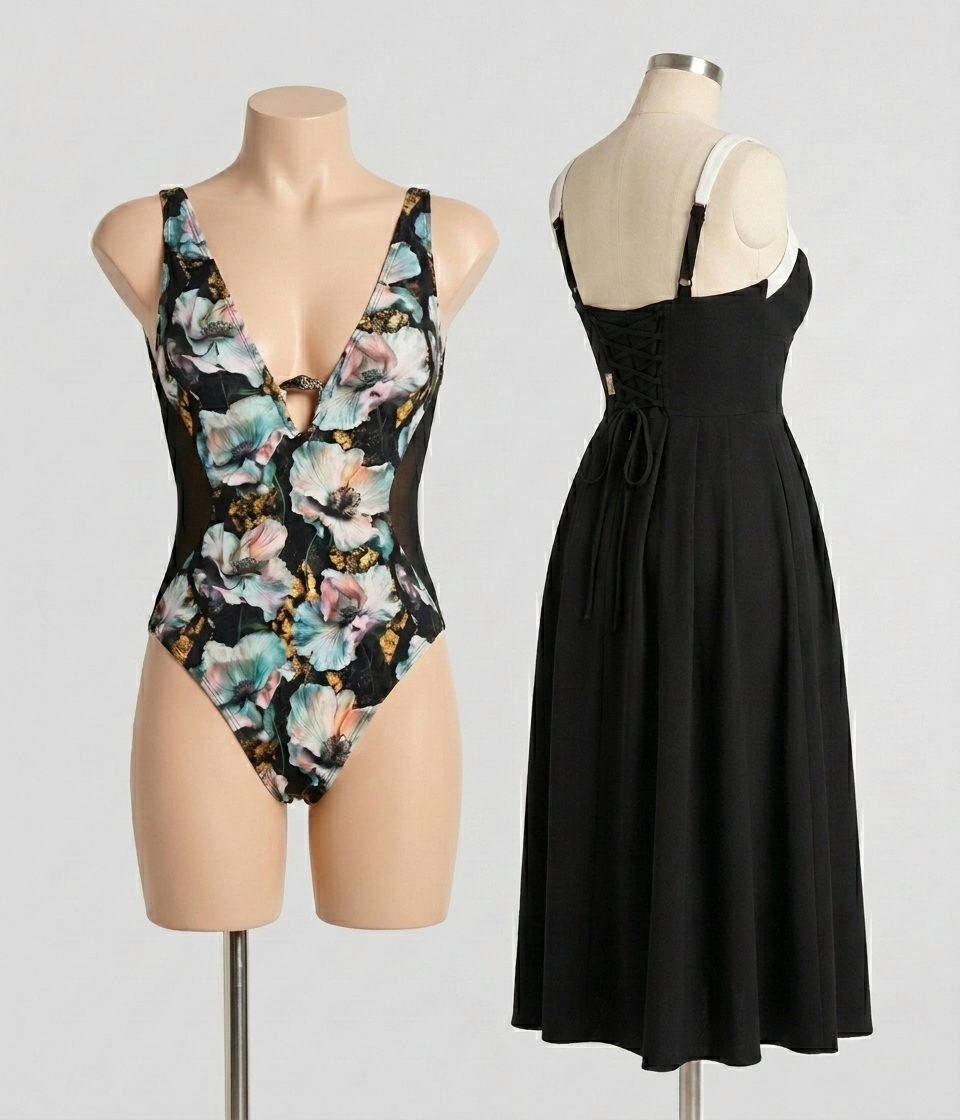
TA3 (ta3swim.com), a Los Angeles-based swim and shapewear label founded by designer Leila Shams, is built entirely around this idea. Shams started the brand after noticing an odd double standard: people wear real shapewear under their clothes, but settle for flimsy, unstructured suits at the pool, where they're often the most exposed of all. She patented a fix: underwire-style support built into the bra, panels running through the core, compression fabric layered instead of single-ply, and lacing reinforced to hold under tension. That construction is what got the brand onto Shark Tank, and press followed from there: InStyle, Cosmopolitan, The Wall Street Journal, among others.
Who Actually Wears Shaping Swimwear
Shaping swimwear isn't one specific body type solving one specific problem. People reach for it for a lot of different reasons:
1. Wanting real bust support without an ill-fitting shelf bra
2. Smoothing the stomach and waist after childbirth, surgery, or just because that's how their body sits that day
3. Fuller-bust sizing that a standard bikini top was never engineered to hold
4. Wanting a suit that stays put during actual swimming, not just posing by the pool
5. Simply preferring a more structured, put-together silhouette, the same way some people prefer structured clothing over loose clothing.
None of these is niche use cases. They're most of the reasons anyone buys shapewear in the first place, just applied to a swimsuit instead of a dress.
Coverage, Cup Size, and Torso Length: The Fit Variables That Actually Matter
Most swimsuit shopping runs into the same problem regular clothes shopping does: one size number is supposed to cover everything, and it doesn't. Shaping swim actually depends on three separate variables, not one:
Coverage on the bottom: Full, hi-cut, cheeky, thong, boy-shortie — these aren't just style choices. They change how the suit sits on your hips and how much smoothing you get through the lower stomach.
Cup size and bust support: An A-B cup and an F-K cup need different bra structures, not the same shelf-bra scaled up. Brands that only build one structure and stretch it across every size tend to lose support once you get to the larger cups.
Torso length: It's also the fit problem people run into most and name least. Get the bust right but the torso wrong, and the suit digs in at the crotch or gaps at the shoulder. Short, regular, and extra-long options exist because that one variable throws off the rest of the fit.
Check torso length and cup size before you check the colour. That's the one habit worth changing.
Questions Worth Asking Before You Buy
Does shaping swimwear feel uncomfortable? Not if it fits right — the compression should feel snug, not like a brace. Real pain when you sit down means the size is wrong, not that shapewear itself is the problem.
Does it hold up for actual swimming, or just standing at the pool? Not really, and that's the idea. The shaping happens in the construction, not in visible padding or bulk. From the outside, a well-built suit looks like a suit that fits.
Does it work for swimming, or just standing around? This depends entirely on the brand. Compression fabric and reinforced seams should be built to hold up in water, not just look good in a photo. A suit designed properly for shapewear will hold its structure through actual laps, not just poolside lounging.
Taking Care of a Shaping Swimsuit
More layers and hardware than a basic bikini means a bit more upkeep:
1. Rinse in cool water right after you take it off — chlorine and saltwater both break down compression fabric faster than plain water does
2. Hand wash rather than machine wash when possible; bonded layers and boning don't hold up well to a washing machine's agitation
3. Skip the dryer entirely and lay flat to air dry.
4. Rotate between two suits if you swim often, so the compression fabric has time to recover its shape between wears.
Treated well, a good shaping swimsuit should outlast a basic one by a wide margin, simply because it's built with more structure to begin with.
The Bottom Line
What This Comes Down To
Shapewear swimwear exists because the logic behind everyday shapewear — support where you need it, smoothing where you want it — holds up just as well at the pool as it does under a dress. The suits that pull it off aren't gimmicks; they're built more like engineered garments than typical beachwear. If you've never tried one, the real adjustment isn't how it feels on. It's realising a swimsuit could do more than just cover you up, and you spent years assuming otherwise.